28 Jul Do You Have the Right Debt for a Swap?
What Seychelles’ Blue Bond Actually Requires, and Why Most Pacific Island Nations Don’t Have It
Mae Bruton-Adams, CEO & Mahina Cole, Sustainable Finance Associate —
originally published on LinkedIn.
Seychelles’ blue bond is often cited as the model for ocean finance in small island states. It should be studied. But its underlying conditions are country-specific, and treating it as a universal model is sending countries down a path that may not exist for them.
Here’s the piece that gets skipped: the bond didn’t come first. A debt swap did.
How the Seychelles model actually works
In 2015-16, The Nature Conservancy and partners raised $20.2 million — a $15.2 million impact capital loan plus $5 million in grants — to buy back $21.6 million of Seychelles’ sovereign debt at a discount. That restructuring capitalized SeyCCAT, the trust that now manages conservation funding, and built the institutional architecture that made everything after it possible. The blue bond itself didn’t launch until 2018, two years later, raising $15 million through a blended structure that combined private impact investment with a World Bank guarantee and concessional financing from the Global Environment Facility. Even the bond needed institutional scaffolding of its own. And tellingly, part of the bond’s proceeds flowed through SeyCCAT, the same trust the swap had created, while the Development Bank of Seychelles managed the investment fund. The bond wasn’t just built after the swap’s architecture; it ran through it.
The swap created the architecture. The bond was layered on top of it. Without the swap, there’s no foundation for the bond to sit on. That sequence is the part worth studying, not just the outcome.
The question that matters before anything else: Do you have the right debt?
Debt swaps are not a general-purpose tool. They work on a specific kind of debt, and most Pacific Island nations, when they look honestly at their books, don’t hold much of it.
Here’s the breakdown
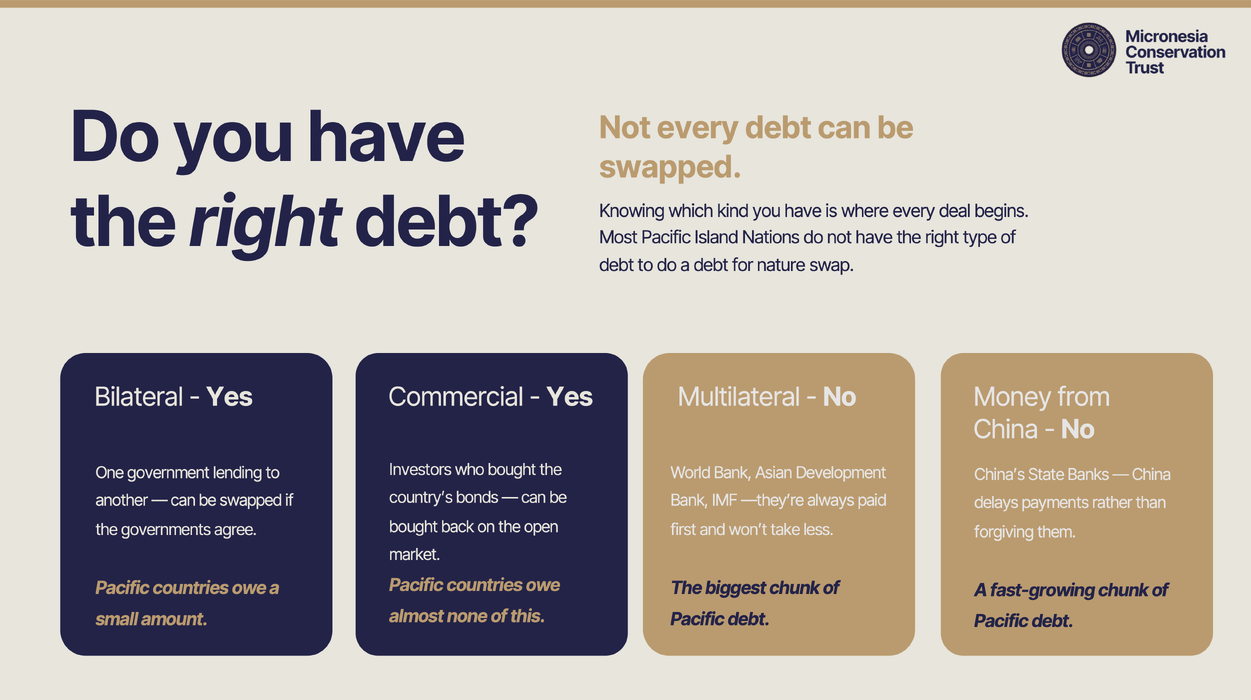
Bilateral debt (like the Paris Club debt Seychelles restructured): This is the debt that swaps are actually built for. A creditor agrees to sell or discount the debt, and a facilitator such as TNC buys it back at a discount, redirecting the savings toward conservation or adaptation. This only works when the debt is large enough to interest a facilitator and a creditor willing to sell.
Multilateral debt (ADB, World Bank): This is generally not swap-eligible, not for political reasons, but because of preferred creditor status. Countries repay these institutions first, even in default, which is what lets multilateral lenders borrow cheaply and hold top credit ratings. Discounting that debt would undercut the model for every other borrowing country, so it doesn’t happen. If a large share of a country’s debt sits here, that share simply isn’t in play.
Debt to China: Often one of the largest categories of bilateral debt for Pacific nations, and the repayment burden is intensifying even as new lending has slowed. China’s lenders do not forgive debt outright. At most, they’ve offered maturity extensions and repayment deferrals, pushing out timelines rather than discounting principal. Much of the debt is classified as commercial rather than concessional, and a discounted sale would mean a state bank booking a loss and setting a precedent across its entire BRI portfolio, not just one country’s debt.
Add it up, and a country can be genuinely debt-burdened and still have almost nothing that qualifies for a Seychelles-style instrument. Being in debt and having the right debt are two different conditions, and the second determines whether this model is even on the table.
This isn’t theoretical
This pattern has played out before. A small Pacific nation’s debt to a single bilateral agency was, on its own, too small for that creditor to seriously consider a swap. Combining it with similar debt held by neighboring countries generated real interest until the creditor agency ultimately said it lacked the authority to approve such a deal and that it would require legislative action in the creditor’s own country. The political window for that legislative action closed before it could be used, and with it, the opportunity.
Every other category of debt on the table faced the same structural problem: multilateral debt that isn’t swap-eligible, and bilateral debt to creditors who don’t swap or forgive. The country wasn’t short on political will or institutional readiness. It was short on the right debt, owed to the right kind of creditor.
What this means for the region
Most Pacific Island nations are in some version of this position: modest bilateral debt, growing multilateral debt, and a heavy, intensifying repayment burden to China. That mix is precisely the mix that makes the Seychelles sequence hard to replicate, no matter how strong the institutional will or the conservation case.
That doesn’t mean ocean finance is off the table for the region. It means the Seychelles model, swap first, bond second, isn’t the only model, and for most Pacific nations, it may not be the one to reach for first.
There are structures that don’t require a creditor willing to sell at a discount, or a swap architecture that doesn’t currently exist; instruments built on what a country already has, rather than on debt it doesn’t. So what’s left, if the debt itself isn’t the right foundation to build on?
More on this to come…
~ Mae and Mahina