

06 Nov From Micronesia to COP31: Scaling 20 Years of Island Leadership
Twenty years after five Micronesian governments launched one of the world's most ambitious regional conservation commitments, the Micronesia Challenge offers a powerful example of what island-led conservation can achieve. With expanded conservation targets and a significant institutional development, the Challenge is entering its next chapter—and offering important lessons for global climate and ocean action at COP31.
*Information on the Micronesia Conservation Trust’s relationship to the Micronesia Challenge can be found here.
The Origins and Evolution of the Micronesia Challenge
In March 2006, the leaders of five Micronesian governments stood before the international community at the eighth Conference of the Parties to the Convention on Biological Diversity and did something almost no one expected. They declared that size didn’t matter, that intent wasn’t enough, that bold action was owed regardless of population, land mass, or available funds, because their resources and their people were worth it.
The Federated States of Micronesia, the Republic of Palau, the Republic of the Marshall Islands, Guam, and the Commonwealth of the Northern Mariana Islands together span an ocean territory the size of the continental United States. They pledged to conserve at least 30% of their near-shore marine resources and 20% of their terrestrial resources by 2020. It was the Micronesia Challenge, and it was their declaration.
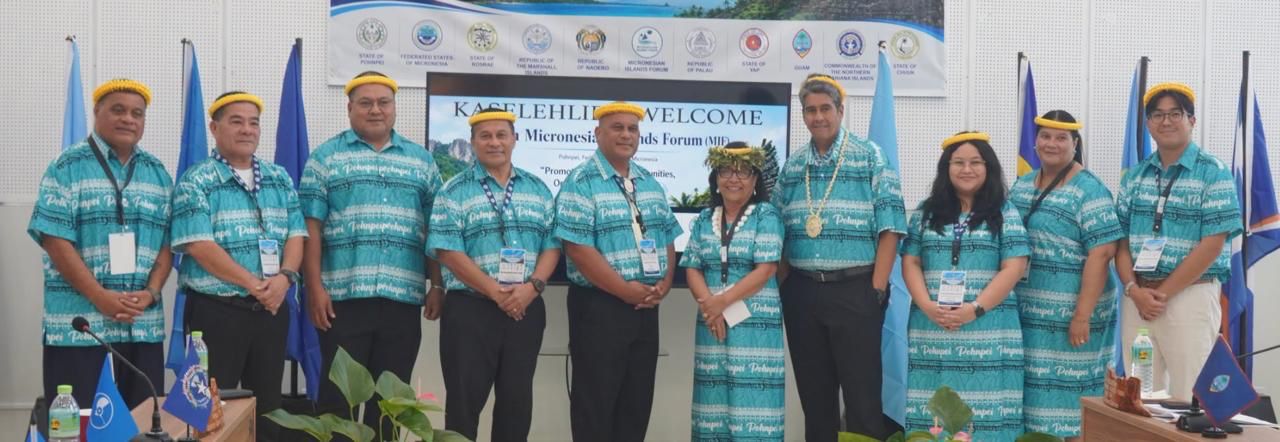
In 2019, the five governments raised their ambition further, committing to 50% effective management of their ocean territory alongside 30% effective conservation of marine and terrestrial resources. Then in 2026, at the Micronesian Islands Forum, they expanded that commitment to 100% effective management of their ocean territory, while maintaining the 30% conservation target.
Since its launch, the Micronesia Challenge has helped leverage more than $100 million for conservation across the region, established over 150 protected areas, and driven new fisheries management policy. It has outlasted 23 changes in government across its five member jurisdictions. Its endowment, for which the Micronesia Conservation Trust (MCT) serves as trustee, has grown to $30 million.
The model has since been echoed well beyond Micronesia, inspiring the Coral Triangle Initiative, the Caribbean Challenge, Hawai’i’s Aloha+ Challenge, and the EU’s BEST initiative for overseas territories.
A New Institutional Era: MCRO as an Intergovernmental Organization
This year, as the Micronesia Challenge turns 20, it marks one of its most significant institutional milestones: the Micronesia Challenge Regional Office (MCRO) has entered a new era as an Intergovernmental Organization, with its first-ever Executive Director, domiciled in the Republic of the Marshall Islands.
The shift matters. For two decades, the Challenge’s coordination sat closer to the NGO and technical-support side of the partnership, including through MCT’s own involvement in supporting its leadership and coordination. That arrangement served the Challenge well in its early years, but it also meant a government-born declaration was, in practice, being coordinated outside of full government hands.
MCRO’s new institutional structure strengthens the five governments’ direct, sovereign ownership of the institution that coordinates their shared commitment, reinforces MCRO’s standing to engage with other governments and international institutions, and clarifies responsibility for delivering the Challenge. It provides a stronger foundation for regional coordination, accountability, and long-term implementation.
MCT’s role shifts accordingly. MCT no longer serves in a secretariat or coordinating capacity for the Challenge. MCT remains its financing mechanism: managing the endowment, raising and stewarding resources, and providing technical support, while MCRO and the five governments it represents now lead, coordinate, and direct the Challenge.
Scaling the Micronesia Challenge Model
The Micronesia Challenge’s significance extends beyond its conservation achievements. It has demonstrated how island governments can establish shared priorities, work across jurisdictions, and build the partnerships and financial mechanisms needed to sustain action over decades.
Scaling this model does not mean duplicating it exactly. Its underlying principles—political leadership, shared commitments, regional collaboration, and long-term financing—can be adapted to different island contexts, allowing governments and communities to establish their own priorities while drawing on Micronesia’s experience.
This opportunity is particularly important as island countries confront the interconnected challenges of climate change, biodiversity loss, and ocean degradation. Healthy marine and terrestrial ecosystems support climate resilience, food security, livelihoods, and community well-being. Yet island nations face significant barriers to accessing the long-term financing needed to protect these resources.
The Challenge’s experience demonstrates the value of locally governed financial institutions that support local decision-making and sustain conservation efforts beyond individual projects and funding cycles.
The Opportunity at COP31
These lessons will be at the center of discussions at COP31 in Antalya, Türkiye, this November.
On November 18, MCT will join the Global Island Partnership (GLISPA) and other partners for a high-level roundtable at the SDG Pavaillion, titled Islands Lead: 20 Years of Island Leadership, Solutions and Implementation.
The discussion will explore how the Micronesia Challenge and other island-led initiatives have influenced conservation and climate resilience efforts around the world, and what their experiences can teach the international community about financing long-term action.
The Micronesia Challenge’s experience points to three priorities for global climate and ocean finance:
Island-led: Financing should follow the priorities established by island governments and communities, strengthening local ownership and decision-making.
Fit for purpose: Funding must be accessible, predictable, and responsive to island realities, with simpler processes that recognize the connections between climate, ocean, and biodiversity action.
Built to last: Long-term conservation and climate resilience require sustained investment in local institutions and financial mechanisms that can deliver results beyond individual projects or political administrations.
The message to the international community is clear: island countries, territories and states are not waiting for solutions to arrive. They have spent decades developing and implementing approaches to ocean stewardship, biodiversity conservation, and climate resilience. The challenge now is to ensure that global financing systems support these efforts at the scale required.
Twenty years after the Micronesia Challenge began, the opportunity at COP31 is to build on what already works: scale proven island-led approaches, strengthen the institutions delivering them, and ensure that climate and ocean finance is island-led, fit for purpose, and built to last.